
Phase Four of the Echo Shaheen Team Project to Develop a Highly Energy-Efficient Electric Prototype Vehicle: [Development of a Lightweight Outer Shell to Improve the Efficiency of a Highly Energy-Efficient Syrian Prototype Vehicle]
By:
From: Damascus – HMK – CE
Supervised by: Dr. Iman Shreihi
Graduation Year: 2026
4.1 Background & Motivation
This project aims to design and manufacture a highly energy-efficient electric vehicle to represent Damascus University and the Syrian Arab Republic in the Shell Eco-marathon Qatar 2027 competition, one of the most prominent international competitions that encourages innovation in sustainable transportation and energy efficiency.
The importance of the project stems from the need to develop innovative engineering solutions that contribute to reducing energy consumption and carbon emissions, in addition to developing students’ experience in mechanical, electrical, and electronic design, control, and practical testing according to international standards. Our team seeks to achieve the first Syrian participation in this international competition, which strengthens the university’s standing, highlights the capabilities of Syrian students in international forums, and contributes to spreading a culture of innovation and sustainable engineering within the academic community.
4.2 Aims & Objectives
General Objective:
Develop a functional Prototype vehicle model by integrating the power and drive system with the initial structure, and create a testing platform that helps improve vehicle efficiency before adopting the final design.
Specific Objectives:
1. Study the outer shell in a manner suitable for the nature of energy-efficiency competitions.
2. Select the materials and the manufacturing method for the outer shell.
3. Improve aerodynamic airflow to increase efficiency.
4. Conduct tests on the outer shell and install it on the vehicle.
4.3 Methodology & Approach
1. Suitable Foam for Making the Mold
We use expanded polystyrene (also known as “beadboard”), as it is inexpensive and widely available. It is often used as home insulation in construction projects and other projects.
2. Foam Shaping
We use polystyrene foam sheets to form the mold, cutting the sheets into suitable sizes to create a foam block slightly larger than the planned project size. The blocks are then bonded together using a polyurethane foaming adhesive, such as Gorilla Glue. This type of adhesive was selected for its strength, ease of use, and foaming property, which makes it easy to sand like the foam itself.
After bonding the pieces together, we make simple cardboard templates for the top and side views. Alternatively, the foam can be cut easily using a CNC machine, or a hybrid method can be used based on cross-sections, filling the gaps with foam and sanding it to match the profile contours. A hot wire can be used, but it does not cut through the adhesive and may be difficult to sand at first, so it is best suited for projects such as airfoil sections and similar shapes.
The initial shaping process is carried out using a conventional wood saw. The foam can be cut easily into the required shape using the saw. To improve the shape further, the other side of the template is used as a sanding guide to refine the shape accurately. This can be done manually or using an orbital sander fitted with 120-grit sandpaper.
To obtain precise finishing touches and form compound curves, we sand the block manually without using templates to ensure sanding accuracy. This stage is critical because it determines the final shape of the project. After that, the block is sanded manually to obtain a smooth surface and complete any fine details and curves.
3. Applying Release Film to the Foam
We use release film to prevent the resin from adhering to the foam. Conventional release agents are not effective. Wrapping the foam with release film is a quick and clean method for separating it efficiently from the polystyrene. We attach the release film to the foam block using a conventional spray adhesive, such as 3M Super 77 or another spray adhesive, then apply the film to the foam block and smooth it while bonding. Small wrinkles are not a problem because they will not appear on the final part.
4. Using a Peel Ply Layer
The first layer in the forming process is the peel ply, which is used to provide a smooth and uniform surface for the inner part. We place the peel ply on the surface, mark the cutting lines on it, and then cut it. At the same time, we use the peel ply as a guide for cutting the carbon fiber.
5. Reinforcement Layup with Epoxy
After wetting the peel ply, we apply the reinforcement layers and wet each layer separately until all three layers have been applied. Care must be taken to wet the carbon fiber thoroughly while distributing the resin through it along the fabric. Flat resin spreaders, squeegees, and even finned rollers are used to distribute the resin.
To prepare the second layer, we remove protrusions from the carbon edges and sand them using 120-grit sandpaper. The second forming process is carried out in the same way as the first, where the peel ply and three layers of carbon fiber cloth are applied to the surface as before. After that, the entire part is left to dry for 24 hours.
6. Installing Supports and Removing Protrusions
After the part has cured, we use 120-grit sandpaper to remove any protrusions or raised edges on its surface. The aim is not to sand the carbon itself, but to remove any minor protrusions.
Project Design
https://saea-us.org/wp-content/uploads/2026/08/IMG_20260813_130708_303.jpg
Needed Material:
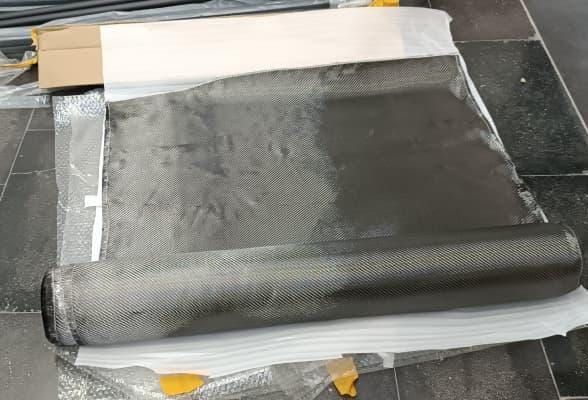
1-3K 200 GSM, 0.2 mm Thickness Carbon Fiber Cloth
Carbon fiber cloth used in the manufacture of lightweight structures. Price quoted by a shipping company in China, including shipping charges.
Quantity and price: 24 m² $700
2-Epoxy Laminating Resin
Epoxy resin used to convert carbon fiber cloth into a rigid composite structure. Price quoted by a shipping company in China, including shipping charges.
Quantity and price: 10kg $315
Total Estimated Cost :1015$