
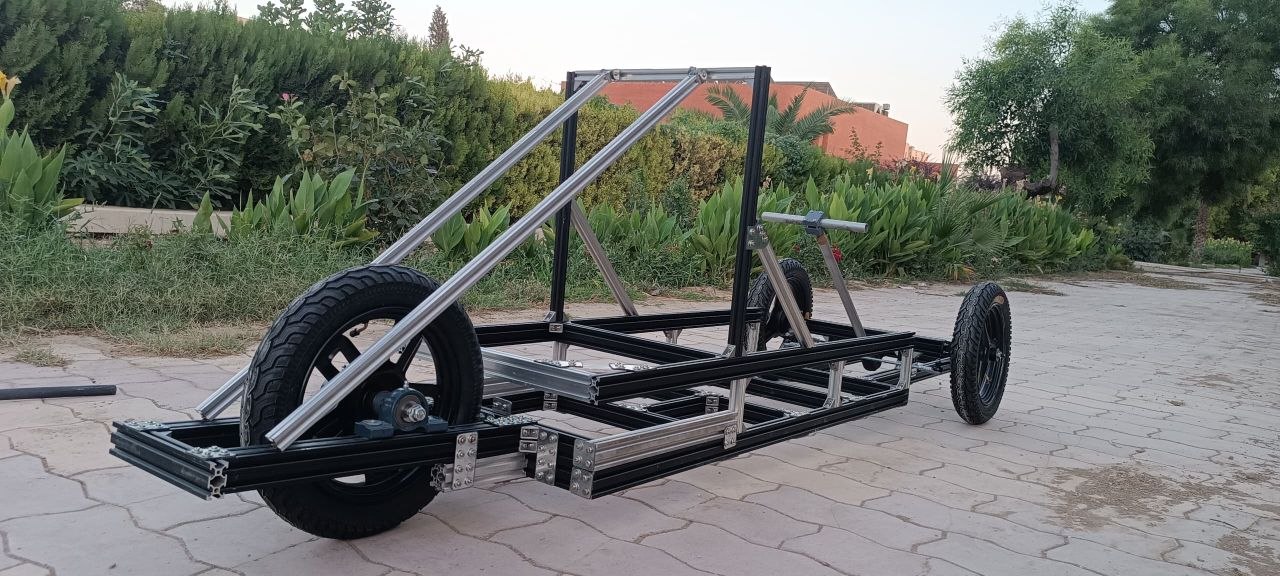
Design and Construction of an Ultra-Efficient Prototype Vehicle Chassis Frame
By:
From: Damascus – HMK – CE
Supervised by: Dr. Eman Shriehi
Graduation Year: 2026
4.1 Background & Motivation
Competition Overview and Global Context The Shell Eco-marathon is recognized as one of the premier global student engineering competitions focusing on innovation and technological sustainability. Unlike conventional automotive competitions, its objective is not speed, but rather maximum energy efficiency; participating student teams design, construct, and operate vehicles engineered to travel the longest possible distance using a minimal amount of fuel or electrical energy. This challenge directly addresses the global crises of climate change and the depletion of conventional energy resources, underscoring the necessity for young engineers to collaborate in developing sustainable technological solutions.
Project Motivation and Problem Statement The primary motivation behind this initiative is to design and fabricate a fully integrated, competitive vehicle to represent the team on the international stage, while addressing a critical constraint in eco-friendly automotive engineering: the trade-off between structural mass and mechanical integrity (“weight vs. structural durability”). Traditional vehicles rely on heavy chassis architectures that incur high energy consumption, whereas conventional lightweight alternatives present significant challenges regarding local fabrication, modification, and resource availability.
Project Significance and Innovative Solution The novelty of this project lies in proposing a pragmatic, structured engineering methodology to overcome these constraints through a modular, low-mass framework. Specifically, an enhanced chassis architecture was engineered using structural aluminum extruded profiles, successfully achieving high operational versatility, ease of modification, and substantial mass reduction.
National and Academic Significance (Damascus University & Eco Shaheen Vision) Driven by exceptional national and academic aspirations, the strategic roadmap of the “Eco Shaheen” team aims to establish the first official, historic entry for the Syrian Arab Republic in this global engineering competition among universities and academic institutions worldwide. Consequently, Damascus University becomes the first academic institution in Syria to pioneer an initiative for designing and manufacturing a high-efficiency vehicle driven by local youth talent, proving the capacity of Syrian engineering minds to innovate and compete globally.
Expected Impact and Broader Implications Aligned with this vision, the Eco Shaheen project transcends the scope of constructing a single competition vehicle; it represents a landmark step toward localizing electric vehicle (EV) and sustainable transportation technologies within Syria. Furthermore, it establishes an inspiring benchmark for future generations, demonstrating that local innovation is fully capable of formulating intelligent solutions for the future of mobility.
.
4.2 Aims & Objectives
Overall Aim To design and fabricate an eco-friendly, ultra-high-efficiency electric vehicle for participation in the Shell Eco-marathon, engineered to maximize driving range per unit energy consumed through the seamless integration of innovative mechanical design and aerodynamic optimization.
Specific and Measurable Objectives
Chassis Development: Design and construct a lightweight, high-rigidity chassis prototype utilizing structural aluminum profiles joined via mechanical fasteners and specialized connectors, thereby reducing fabrication time and enabling modular maintenance and structural modifications.
Structural Mass Optimization: Optimize the overall vehicle mass by strategically exploiting the favorable strength-to-weight ratio and mechanical properties of aluminum.
Numerical Validation and Structural Safety: Ensure driver safety and component integrity by achieving a high factor of safety (FoS) through Finite Element Method (FEM) stress analysis in ANSYS, alongside geometric validation of steering kinematics to eliminate dynamic instability or tracking deviation during operation.
Aerodynamic Optimization: Minimize the aerodynamic drag coefficient ( C d
) of the fiberglass-molded outer body shell to ensure it remains below a strictly defined target threshold.
4.3 Methodology & Approach
Chassis and Steering System Design
The structural frame (chassis) was engineered with high precision using SolidWorks 2025, adhering strictly to the dimensional constraints specified in the official competition rulebook to optimize spatial allocation for the motor compartment, battery pack, and driver cockpit. Concurrently, the steering system was developed, with steering geometry precisely calculated and modeled to ensure dynamic stability and smooth cornering along the track trajectory.
Computational Simulation and Structural Analysis
To guarantee structural safety while optimizing mass, the chassis underwent advanced computational simulations in ANSYS. Finite Element Analysis (FEA) was conducted to evaluate stress distributions and load-bearing capacity under combined operational forces, including dead load, driver mass, and electrical payloads. Furthermore, steering kinematics and turning radii were virtually validated to ensure optimal vehicle dynamic performance.
Mechanical Assembly
Chassis construction utilized high-strength, lightweight extruded aluminum profiles, integrated with a custom-fabricated floorboard. To maintain structural modularity and facilitate field maintenance or design modifications, structural members were mechanically joined using dedicated connectors and securely fastened via bolts, establishing a robust, vibration-resistant structural frame.
Aerodynamic Analysis and Styling
Primary focus was directed toward minimizing the aerodynamic drag coefficient ($C_d$) to achieve maximum energy efficiency. Guided by aerodynamic simulations, the streamlined outer envelope was digitally modeled, physically prototyped, and surface-finished using a specialized vinyl layer to produce a flawless, ultra-smooth surface, effectively preventing boundary-layer separation and airflow turbulence during operation.
Mold Fabrication and Composite Manufacturing
Utilizing the prepared physical master model, a high-precision fiberglass mold was constructed. This mold was subsequently employed to fabricate the vehicle’s final outer body shell, yielding an ultra-lightweight yet structurally resilient composite structure capable of enduring ambient operational and environmental stresses.
Project Design
https://saea-us.org/wp-content/uploads/2026/08/photo_2026-08-13_13-50-19.jpg
Needed Material:
Financial Costs Breakdown
M4 Profile T-Nuts — T-slot nuts for structural aluminum profile assembly.
Quantity: 600 | Unit Price: $0.02 | Estimated Cost: $12.00
2020 Extruded Aluminum Profiles — Structural reinforcement members.
Quantity: 6 | Unit Price: $10.00 | Estimated Cost: $60.00
2040 Extruded Aluminum Profiles — Primary chassis structural members.
Quantity: 16 | Unit Price: $13.00 | Estimated Cost: $208.00
20×20 Corner Brackets — Structural angle connectors for chassis assembly.
Quantity: 200 | Unit Price: $0.40 | Estimated Cost: $80.00
M4 Stainless Steel Bolts — Fasteners for chassis and component mounting.
Quantity: 800 | Unit Price: $0.013 | Estimated Cost: $10.40
M5 Stainless Steel Bolts — Fasteners for sub-assembly integration.
Quantity: 10 | Unit Price: $0.013 | Estimated Cost: $0.13
M8 Structural Bolts — Fasteners for steering system mounting.
Quantity: 8 | Unit Price: $0.071 | Estimated Cost: $0.57
Brake Assemblies — Deceleration and service brake system.
Quantity: 30 | Unit Price: $3.00 | Estimated Cost: $90.00
Wheels & Tires — Rolling assembly for vehicle locomotion.
Quantity: 3 | Unit Price: $25.00 | Estimated Cost: $75.00
Wheel Axle Shafts — Axles for wheel retention and mounting.
Quantity: 3 | Unit Price: $1.40 | Estimated Cost: $4.20
Ball Bearing (620K BW) — Steering shaft positioning and retention bearing.
Quantity: 2 | Unit Price: $0.75 | Estimated Cost: $1.50
Rod End Joint (IKO LHSA 8) — Spherical rod ends for steering linkage system.
Quantity: 4 | Unit Price: $3.50 | Estimated Cost: $14.00
Ball Bearing (NSK 6200) — Deep groove bearings for front wheel hub assembly.
Quantity: 4 | Unit Price: $2.50 | Estimated Cost: $10.00
M8 Threaded Rods — Threaded tie rods for steering geometry linkage.
Quantity: 2 | Unit Price: $0.50 | Estimated Cost: $1.00
Bearing Housing (P201) — Pillow block bearing units for rear axle assembly.
Quantity: 2 | Unit Price: $8.00 | Estimated Cost: $16.00
Chrome Shaft (Ø14 mm, L=500 mm) — Axle shaft for rear wheel hub retention.
Quantity: 1 | Unit Price: $2.50 | Estimated Cost: $2.50
M5 Thread Tap — Internal thread cutting tool for aluminum extrusions.
Quantity: 1 | Unit Price: $1.10 | Estimated Cost: $1.10
Flat Washers — Load-distribution washers for threaded joints.
Quantity: 800 | Unit Price: $0.007 | Estimated Cost: $5.60
Aluminum Tubing (Ø22 mm, L=1.5 m) — Heavy-duty tube for steering column assembly.
Quantity: 1 | Unit Price: $4.70 | Estimated Cost: $4.70
Aluminum Block (400×400×60 mm) — Raw stock for CNC machining of steering components.
Quantity: 1 | Unit Price: $80.00 | Estimated Cost: $80.00
Brass Block (100×200×100 mm) — Raw stock for machining custom steering bushings.
Quantity: 1 | Unit Price: $50.00 | Estimated Cost: $50.00
Steel Block (100×100×100 mm) — Raw stock for machining brake caliper brackets.
Quantity: 1 | Unit Price: $20.00 | Estimated Cost: $20.00
Aluminum Sheet (1×1 m, 2 mm) — Firewall, floorboard, and electrical enclosure panels.
Quantity: 15 | Unit Price: $2.00 | Estimated Cost: $30.00
Vinyl Surface Film — Surface smoothing film for master plug and mold creation.
Quantity: 40 | Unit Price: $2.50 | Estimated Cost: $100.00
Driver Seat — Lightweight ergonomic seating system.
Quantity: 1 | Unit Price: $50.00 | Estimated Cost: $50.00
High-Performance Grease — Synthetic lubricant for rear axle bearing housings.
Quantity: 1 | Unit Price: $8.00 | Estimated Cost: $8.00
Five-Point Racing Harness — FIA-compliant safety harness system for driver protection.
Quantity: 1 | Unit Price: $65.00 | Estimated Cost: $65.00
TOTAL REQUESTED FUNDING: $999.70
Total Quantity: 2,554