
Echo Shaheen III: Developing a Lightweight Chassis to Enhance the Energy Efficiency of a Syrian High-Efficiency Prototype Vehicle
By:
From: Damascus – HMK – CE
Supervised by: Dr. Eman Shriehi
Graduation Year: 2026
. ( الملخص / الملخّص )
ملخص تنفيذي
يمثل هذا المشروع إنجازًا تاريخيًا رائدًا بقيادة فريق “إيكو شاهين” من جامعة دمشق، تحت رعاية حاضنة نمو التكنولوجيا، بهدف ضمان أول مشاركة رسمية للجمهورية العربية السورية في ماراثون شل البيئي الدولي (قطر 2027). ويواجه قطاع النقل المعاصر حاليًا معضلةً حاسمةً تتمثل في هدر الطاقة بشكل كبير والوزن الهيكلي المفرط للمركبات التقليدية، وكلاهما يعيق بشدة التحول العالمي نحو الاستدامة.
للتخفيف من هذا التحدي، تُقدّم هذه المبادرة منهجية هندسية مبتكرة ومتدرجة المراحل لتصنيع نموذج أولي لمركبة كهربائية فائقة الكفاءة. يبدأ الإطار المعتمد ببناء هيكل هيكلي أولي باستخدام قطاعات ألومنيوم ليكون بمثابة منصة اختبار مادية ورقمية. تُسهّل هذه المنصة التحقق الشامل من تكامل الأنظمة الفرعية، وتحديدًا آليات التوجيه ووحدات الكبح ومصفوفات البطاريات، وذلك بالاستفادة من النمذجة الحاسوبية عالية الدقة عبر برنامج SolidWorks 2025 ومحاكاة Ansys.
بعد إتمام إجراءات التحقق الأساسية بنجاح، ينتقل التصميم إلى مرحلته المتقدمة والحاسمة. في هذه المرحلة، يتم إيقاف استخدام قطاعات الألمنيوم القديمة تدريجيًا واستبدالها بأنابيب من ألياف الكربون فائقة الخفة. بالتزامن مع ذلك، تُستبدل الأقواس والمثبتات المعدنية المعقدة بمكونات مُحسّنة مصنعة بتقنية الطباعة ثلاثية الأبعاد باستخدام خيوط ألياف الكربون، بينما تُحسّن بيئة عمل مقعد السائق باستخدام صفائح من ألياف الكربون عالية المتانة. يُغلّف هذا الهيكل الداخلي الشامل لاحقًا بغلاف خارجي انسيابي من الألياف الزجاجية مصمم لتقليل قوى السحب الهوائي.
النتيجة المتوقعة لهذا التدخل الهندسي هي تقليل الكتلة الهيكلية بنسبة تتجاوز 50% لهيكل السيارة، مما يُحسّن كفاءة الطاقة إلى أقصى حد، ويُنتج سيارة سباق متكاملة وجاهزة للمنافسة. وبعيدًا عن حدود حلبة السباق، يُعد هذا الإنجاز خطوة وطنية رائدة نحو تطوير وتوطين وتسريع تقنيات هندسة السيارات والمركبات الكهربائية المستدامة في سوريا، بقيادة جامعة دمشق لأول مرة.
4. وصف المشروع / وصف المشروع
4.1 الخلفية والتحفيز / الخلفية والدوافع)
سياق الأزمة العالمية والمنافسة
The contemporary transportation sector faces a dual challenge characterized by the accelerated depletion of conventional energy sources and an alarming rise in greenhouse gas emissions driving climate change. In response to these critical challenges, the Shell Eco-marathon (Qatar 2027) emerges as a premier global engineering and academic platform centered on sustainability and technological innovation. The core objective of this competition shifts the focus away from vehicular speed; instead, it is entirely predicated on maximizing energy optimization. It challenges student cohorts to design, iterate, and manufacture ultra-efficient vehicles capable of traversing the maximum possible distance utilizing the absolute minimum amount of energy.
National Vision and Motivations
The primary objective of this research initiative is to design and fabricate a high-efficiency, energy-optimized electric vehicle to represent Damascus University and the Syrian Arab Republic on this prestigious international stage. The significance of this project stems from its pioneering and historic nature; the “ECO SHAHEEN” team aspires to secure the first-ever Syrian participation in this global venue. This endeavor aims not only to elevate the university’s international academic standing and highlight the exceptional technical capabilities of Syrian engineering students, but also to cultivate a culture of innovation and sustainable engineering within the Syrian academic community, while effectively localizing electric vehicle technologies.
Engineering Challenge and Two-Stage Phased Methodology
To achieve peak energy efficiency, the team confronted a major engineering bottleneck: the vehicle’s structural mass. To address this challenge, a unique, two-stage structural strategy was adopted to develop the vehicle’s internal chassis independently of the aerodynamic fiberglass exterior shell:
1. Phase I: Developmental Aluminum Chassis and Mechanical Validation:
The initial phase involved constructing a prototype structural framework utilizing mechanically fastened aluminum profiles, connectors, and high-tensile bolts, following extensive computer-aided design (CAD) modeling and finite element simulations in SolidWorks 2025 and Ansys. The primary objective of this metallic framework was to serve as a physical kinematic testbed for the complete installation, integration, and calibration of all critical subsystems. This included validating the steering geometry and wheel alignment, the braking system, motor mounting configuration, battery housing protection, and driver ergonomics, thereby confirming their dynamic performance and real-world mechanical compatibility.
2. Advanced Phase: Carbon Fiber Structural Transition:
Upon successful completion of comprehensive testing, alignment verification, and structural cohesion analysis on the aluminum platform, the project transitions into its final production phase. The developmental metallic chassis is fully decommissioned and remanufactured using Carbon Fiber Reinforced Polymer (CFRP), while strictly maintaining the geometric constraints of the external fiberglass shell. This advanced transition guarantees a structural weight reduction exceeding 50% compared to the aluminum predecessor, while simultaneously delivering exceptional torsional rigidity and an elevated factor of safety (FoS). Consequently, this minimizes the vehicle’s inertial forces and optimizes it to achieve maximum mileage with minimal energy consumption, positioning the team to compete effectively for top ranks in Qatar.
.
4.2 Aims & Objectives / الأهداف والغايات
Overall Aim
The overarching objective of this project is to develop an ultra-efficient, eco-friendly futuristic vehicle prototype to represent Damascus University at the Shell Eco-marathon (Qatar 2027). The core focus centers on minimizing the total structural mass relative to the predecessor vehicle, thereby reducing inertial forces and optimizing energy efficiency to its theoretical upper limit.
Specific and Measurable Objectives
1. Mechanical Validation via Aluminum Prototyping: Constructing an initial structural chassis utilizing bolted aluminum profiles and connectors to serve as a kinematic testbed. This physical platform will be deployed to evaluate, calibrate, and validate the real-world mechanical compatibility of the steering, braking, and electrical systems.
2. Digital Engineering and Structural Analysis: Developing high-fidelity computer-aided designs (CAD) of the chassis and steering assembly using SolidWorks 2025, followed by advanced finite element analysis (FEA) simulations via Ansys to ensure a high factor of safety (FoS) for the driver prior to physical fabrication.
3. Radical Mass Reduction (Carbon Fiber Transition): Completely substituting the developmental aluminum chassis with a carbon-fiber-reinforced structure, aiming for a targeted mass reduction exceeding 50% compared to the legacy metallic prototype, while strictly preserving the geometric envelope and external aerodynamic shell.
4. Operational Readiness and International Competition: Executing comprehensive field-testing routines and driving simulations on the optimized vehicle to guarantee compliance with the mandatory technical inspection of the competition, ensuring high-performance readiness for the Qatar track events.
4.3 Methodology & Approach / المنهجية وأسلوب العمل
Methods, Tools, Materials, and Techniques
لتحقيق الهدف الأساسي المتمثل في تقليل وزن مركبة فريق “إيكو شاهين” وتعزيز كفاءتها، تم الانتقال من هيكل معدني تقليدي إلى هيكل متطور يعتمد على المواد المركبة وتقنيات التصنيع الإضافي. وتتلخص منهجية العمل في الركائز الأساسية التالية:
• مواد:
o أنابيب ألياف الكربون: تعمل هذه الأنابيب كبديل استراتيجي لقطاعات الألمنيوم، وتتميز بطبيعتها خفيفة الوزن للغاية، وصلابتها الهيكلية الهائلة، وقدرتها العالية على تخميد الاهتزازات.
o خيوط ألياف الكربون ثلاثية الأبعاد المتقدمة: استخدام خيوط متخصصة مثل (PETG-CF أو Nylon-CF) في طباعة مكونات الربط الميكانيكية لتوفير متانة ميكانيكية ممتازة بوزن أقل بكثير مقارنة بالمعادن التقليدية.
o صفائح وقضبان ألياف الكربون: تستخدم لتصنيع الأسطح المستوية داخل قمرة قيادة السائق.
Project Design
https://saea-us.org/wp-content/uploads/2026/08/IMG_20260813_134608_829-scaled.jpg
Needed Material:
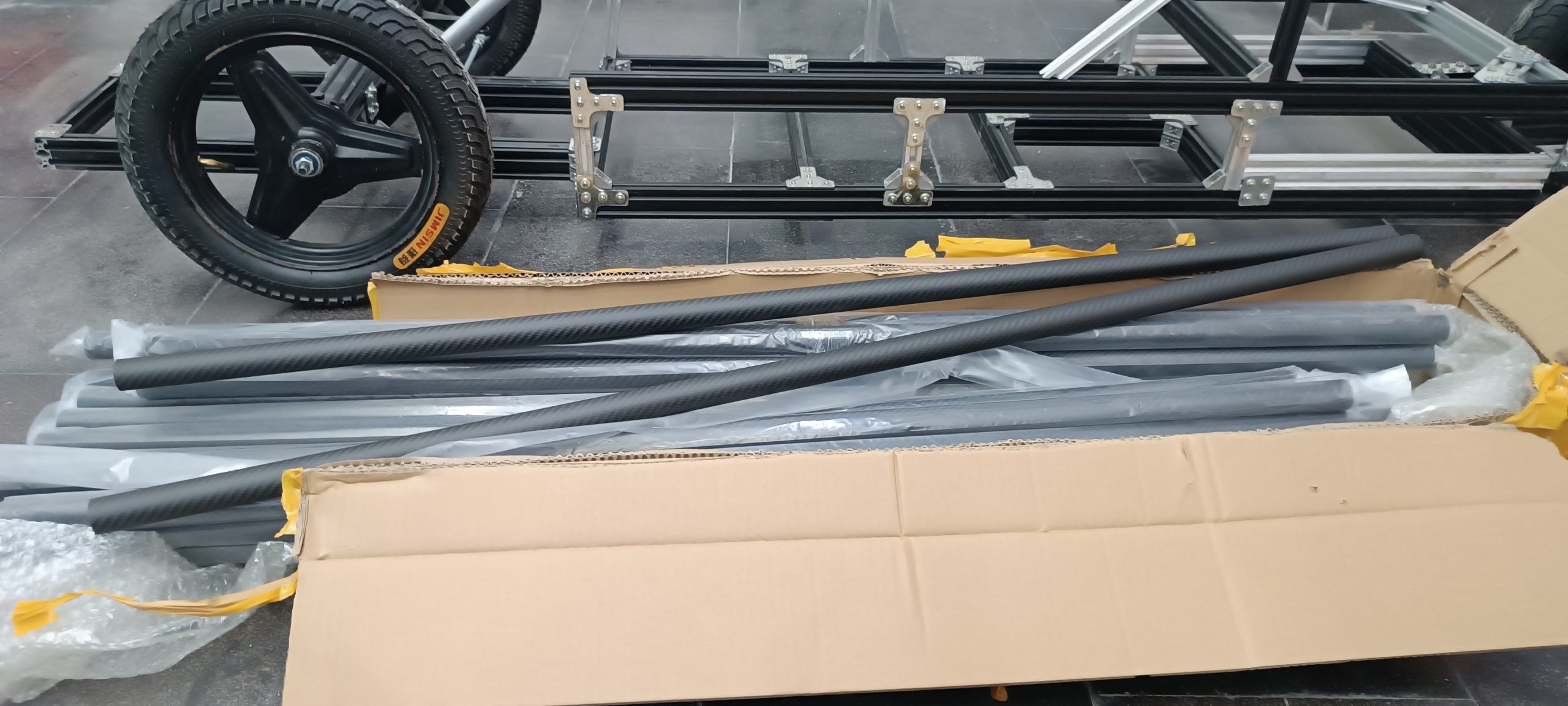
The procurement for this phase consists of three core carbon fiber components, with all logistics and sourcing quoted directly by a Chinese freight forwarder inclusive of shipping fees. For the chassis frame construction, twenty pieces of high-strength, lightweight Carbon Fiber Tubing (Ø25×27 mm, 1.2 m each) are allocated at an estimated cost of $400.00. The driver floorboard and cockpit enclosure require two square meters of composite Carbon Fiber Sheets, also valued at $400.00. Additionally, two spools of Carbon Fiber Filament for 3D printing and additive manufacturing applications are included at an estimated cost of $200.00. Summing up these allocations, the total estimated cost for the material procurement is $1,000.0