
AADS: Advanced Autonomous Drone System
By:
From: Damascus - HMK - CE
Supervised by: Mofeid Hadad
Graduation Year: 2026
The Problem:
In the aftermath of natural disasters and industrial catastrophes, communication infrastructure collapses, roads become impassable, and every second counts. Conventional drone systems either depend on continuous cloud connectivity or require a ground station for real-time processing — both of which fail precisely when they are needed most. Search-and-rescue teams are left without aerial intelligence at the exact moment lives are at stake.
The Solution:
AADS is a fully autonomous, edge-computing quadcopter platform designed to operate as a flying decision-making agent in infrastructure-free disaster zones. It detects victims in real time, geo-references their positions, and autonomously dispatches ground rescue teams — all without any cloud link, internet connection, or external processing station.
Expected Impact:
Scalability: At roughly 1/20th the cost of comparable commercial systems (Skydio X10, DJI Dock 2, Teal 2), AADS enables fleet deployment for wide-area coverage. Its modular, open-architecture design supports future expansion to swarm coordination, GPS-denied SLAM navigation, and decentralized multi-agent intelligence — positioning it as a scalable platform for disaster management, critical-infrastructure surveillance, and humanitarian operations worldwide.
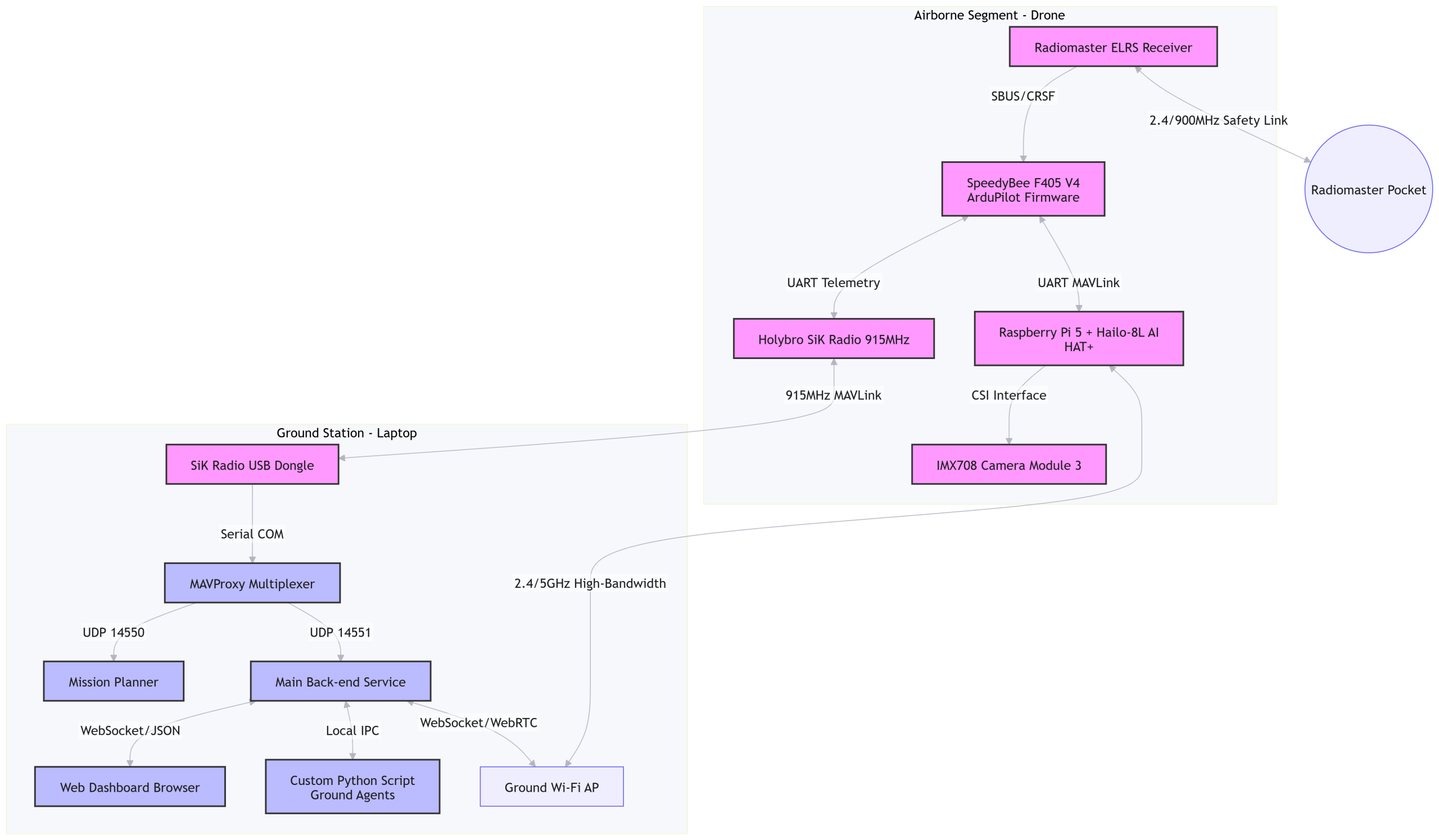
Project Design
https://saea-us.org/wp-content/uploads/2026/08/1.-System-Context-Hardware-Integration-Diagram-scaled.png
Needed Material:
Flight Controller (SpeedyBee F405 V4): 70
Frame (S500): 48
Sik Telemetry Radio V3: 94
Brushless Motors (2213 935KV): 55
GPS (M8N): 22
Propellers (1045): 3
Camera Module 3 (12MP): 48
Battery (LiPo 3S 6000mAh): 66