
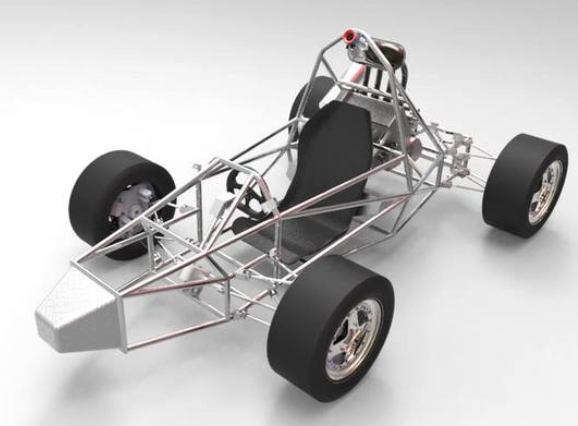
Design and Implementation of an Electric Sports Vehicle Chassis and Powertrain System Formula Student .
By:
From: Damascus – HMK – CE
Supervised by: Dr. Rayad Kubaisi
Graduation Year: 2026
Note: This project is integrated with another project in the faculty.
Abstract
This project represents an integrated engineering application aimed at designing and
manufacturing a single-seat electric race car to participate in international “Formula Student”
competitions. The project focuses on two main sections that represent the backbone of the vehicle:
the structural chassis and the electric powertrain system.
The chassis design aims to achieve a difficult equation combining lightweight and high
torsional stiffness to ensure driver safety and improve the car’s response in fast corners.
Project Description
Below is a comprehensive and detailed presentation of the integrated engineering project to design
and implement an electric race car in the “Formula Student” category, incorporating all design and
executive aspects and targeted metrics.
1. Introduction & Background
The global automotive industry is witnessing a radical and qualitative shift towards full reliance on
clean energy and Electric Vehicles (EVs). In this context, Formula Student competitions are the
most prominent global academic and research platform for challenging young engineering minds,
where student teams are required to design, build, and test a single-seat race car according to
highly strict technical and operational regulations.
This project comes as a scientific and practical response to this technological shift, focusing on
combining innovative engineering solutions in mechanical and dynamic design with advanced
technologies in electric powertrain and energy management systems, which contributes to
preparing a generation of engineers capable of leading the sustainable transportation sector in the
future.
2. Project Objectives
Integrated Engineering Design: Innovate and design a structural chassis and electric
powertrain system that achieves the optimal balance between high performance, light weight,
and reliability.
•
•
•
•
•
Page 2 of 9
Physical Manufacturing and Implementation: Transition from digital blueprints and
computer models to the actual manufacturing of all vehicle parts and testing them on a real
track.
Commitment to International Safety Standards: Meet and pass all safety conditions and
technical scrutineering of the global Formula Student rules, especially regarding High Voltage
systems.
Technology Localization and Expertise Building: Acquire and develop deep practical
knowledge in battery assembly technologies and developing embedded software to control
electric mobility systems.
3. Scope of Work & Technical Details
Chassis, Suspension & Aerodynamics Design and Implementation
Structural Chassis: The scope focuses on engineering an advanced chassis. Options are
studied between a reinforced 3D Steel Space Frame relying on structural triangulation to
ensure high durability, or a Carbon Fiber Monocoque to minimize weight to its lowest limit.
The design is subjected to precise stress simulations (FEA) to ensure Torsional Stiffness and
impact resistance to protect the driver.
Suspension and Steering System: Design an independent Double Wishbone suspension
system equipped with Push-rod or Pull-rod struts, with steering geometry dimensions to
provide maximum grip and dynamics in sharp corners.
Aerodynamic Package: Develop front and rear wings and a bottom diffuser via
Computational Fluid Dynamics (CFD) simulation to generate Downforce that increases the
vehicle’s speed in corners without excessive Drag.
4. Methodology & Implementation Plan
The project follows a structured engineering methodology divided into overlapping time phases:
Study and Research Phase: Analyze the technical rules of the competition, review previous
research, and determine the initial dimensions and specifications of the vehicle.
Digital Design and Simulation Phase: Draft all parts using Computer-Aided Design (CAD)
software such as SolidWorks, and perform stress and aerodynamic simulations to ensure
design safety before purchase or manufacturing.
Procurement and Component Assembly Phase: Secure electric cells, motor, inverter, and
the metals or carbon fibers required for the chassis.
Mechanical and Electrical Manufacturing and Assembly Phase: Includes precise welding
of the chassis, metal machining via CNC, building carbon plates, assembling cells inside the
battery box, and laying the wiring network and safety harnesses.
Programming and Calibration Phase: Adjust the settings of the inverter and BMS, and
program the Vehicle Control Unit (VCU).
Track Testing and Development Phase: Initial vehicle operation, data collection via
Telemetry sensors, and adjusting suspension and transmission systems based on actual
performance.
Background & Motivation
Within the framework of developing curricula and laboratories at Damascus University –
Department of Automotive and Heavy Machinery Engineering, there is no educational platform
supporting the educational process related to electric vehicles.
This project aims to provide a platform that can be built upon to implement real student projects,
supporting the localization of electric vehicle culture in Syria and at Damascus University, and
enabling the execution of student projects that foster real teamwork.
6. Expected Results & Conclusion
Project Deliverables & Outputs
The Formula Student electric race car project will result in tangible (engineering and technical) and
cognitive outputs, which are:
Track-Ready Real Race Car: A fully electric single-seat (Formula-style) race car compliant
with the technical and safety rules of the global Formula Student competition.
Manufactured and Tested Chassis: An integrated structural chassis, whether tubular or a
carbon fiber monocoque, characterized by high torsional stiffness, light weight, and equipped
with an Aerodynamic Package to increase stability.
Engineering Design File (Engineering Design Report): Comprehensive engineering
documentation including design calculations, Stress Simulation (FEA) results, and
Computational Fluid Dynamics (CFD) simulations.
Expected Impact & Contribution
The impact of this project extends beyond merely building a race car to encompass educational,
environmental, and technical dimensions:
Preparing Engineering Cadres for the Future Market: The project contributes to bridging
the gap between theoretical academic education and practical application. Students gain
rare experience in advanced engineering fields like clean energy vehicles, energy
management, and embedded systems.
Supporting and Localizing Electric Vehicle (EV) Technology: The project represents a
cornerstone for local research and development in the sustainable transportation sector by
innovating local solutions for battery assembly and electric motor control.
Enhancing Teamwork and Project Management Skills: The project contributes to
developing crisis management skills, working under time and limited budget pressures,
marketing, and securing sponsors—which are essential leadership skills.
Project Design
https://saea-us.org/wp-content/uploads/2026/08/Screenshot-2026-08-17-133818.png
Needed Material:
Financial Costs Breakdown
Item / Category Description Qty Estimated Cost
Chassis Metal pipes 8 $56
Chassis Accessories Welding rods, discs, and transport fees – $70
Suspension System
Dampers 4 $100
Wheel Hubs / Uprights 4 $40
Wheels & Tires – 4 $120
Steering System
Universal Joint (Hooke's) 2 $20
Steering column and bearings 4 $32
Steering rack and tie rods 1 $160
Steering Accessories Steering wheel 1 $20
Braking System
Pedals and master cylinders 1 $50
Discs and brake pads 4 $200
Driver Seat – – $30
TOTAL REQUESTED FUNDING $898