
Edge-Detect: A Real-Time, Mission-Aware IoT Sensing System with Predictive Edge AI
By:
From: Latakia – Informatics Engineering
Supervised by: Dr. Rony Kassam
Graduation Year: 2027
My email is rony.kassam@latakia-univ.edu.sy , I put gmail, because there is a problem in Latakia University domain.
Problem Statement:
Current urban traffic monitoring systems face three major challenges:
(1) traditional cloud-based processing introduces high latency, failing to meet real-time traffic management requirements;
(2) the optimal edge computing architecture remains unclear – should AI tasks be offloaded to intermediate edge gateways, or should deep learning models execute directly on the camera (true edge processing)?
(3) there is a lack of a unified embedded system platform that integrates real-time scheduling, machine vision, predictive edge AI, and mission-critical fault tolerance.
Proposed Solution:
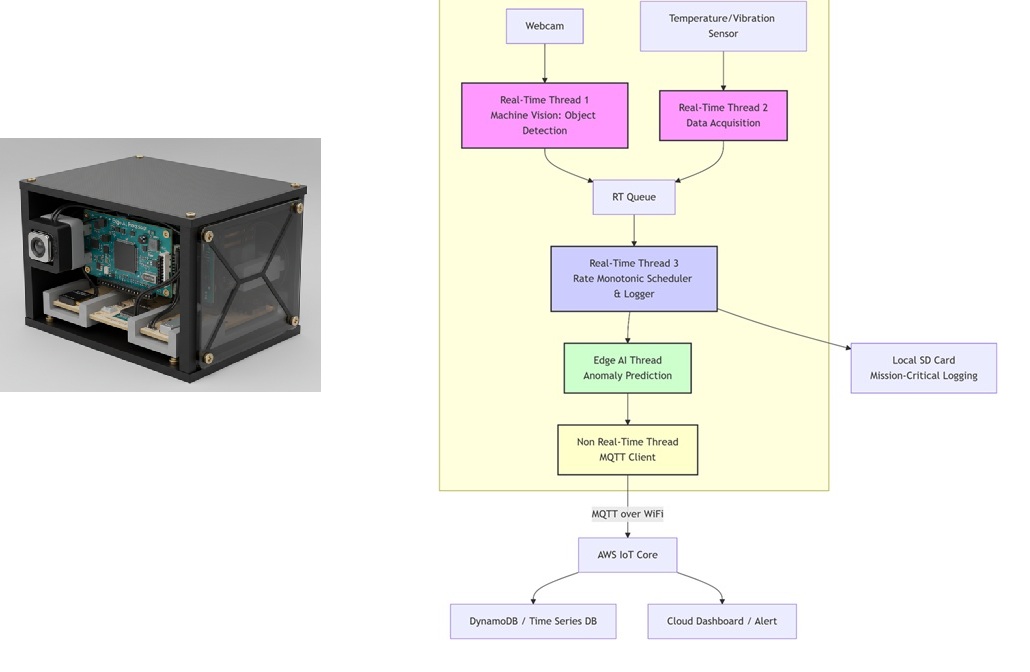
This project, “Edge-Detect,” designs and implements an advanced real-time Smart Camera System for traffic monitoring and management. The system integrates six core competencies that map directly to our Master’s program courses:
Machine Vision – Real-time object detection and tracking using OpenCV (from the Real-Time Project course)
Real-Time Scheduling – Rate Monotonic theory for multi-threaded task scheduling (from Theory & Analysis course)
IoT Communication – MQTT protocol with secure AWS IoT Core connection for alerts (from M2M/IoT course)
Edge AI Prediction – Lightweight LSTM/Random Forest models to predict future sensor values (from AI/Edge Computing course)
Mission-Critical Fault Tolerance – Watchdog timer + redundant SD card logging + software ECC (from Mission-Critical course)
Real-Time OS – Linux with RT-PREEMPT kernel, using POSIX threads (from Concepts & Practices course)
Research Innovation:
This project investigates real-time scheduling and processing across two distinct architectural approaches:
(a) offloading tasks to intermediate edge gateway nodes vs.
(b) executing deep learning models directly on-camera (true edge processing). This comparative study will provide essential engineering design references for smart city infrastructure development.
Scalability & Deployment Framework:
Beyond the prototype, this project establishes a viable logistics framework for large-scale deployment. Recognizing that sourcing large volumes of specialized smart cameras directly from manufacturers is complex, I am partnering with Original Design Manufacturers (ODMs) to handle physical assembly and deployment locally here in Syria, coupled with targeted external training. Crucially, one of our Master’s students originates from Idlib and currently holds a position within state institutional channels; he has verified that he can safely facilitate the logistics and secure delivery of this equipment directly to our university department. This ensures that once the prototype is validated, the system can be scaled to deploy up to 2,500 smart cameras for nationwide traffic monitoring and management, directly benefiting Syrian infrastructure.
Expected Benefits:
Establishes an advanced edge AI laboratory ecosystem, training 8 Master’s students as high-caliber embedded systems researchers
Produces publishable research comparing edge-offloading vs. true-edge processing trade-offs
Delivers a deployable prototype for traffic management in Syrian smart city initiatives
Open-source GitHub repository ensures reproducibility and scalability
Project Design
https://saea-us.org/wp-content/uploads/2026/07/Plan.jpg
Needed Material:
# Item Model / Part # Description Qty Est. Cost (USD)
1 Edge AI Processor (Primary) NVIDIA Jetson Orin NX 16GB Developer Kit High‑performance AI module with 100 TOPS, 16GB RAM. 1 $450
2 Camera for Jetson Orin Arducam IMX219 8MP CSI Camera High‑resolution CSI camera for live video streaming, directly connecting to the Jetson’s CSI port 1 $25
3 Power Supply for Jetson Orin 19V Power Adapter (Orin‑compatible) Required to power the Orin NX Developer Kit 1 $30
4 Secondary Platform (Linux/RT‑PREEMPT) Raspberry Pi 5 (4GB) 64‑bit quad‑core Arm Cortex‑A76 @2.4GHz. Runs Linux + RT‑PREEMPT with POSIX threads for the real‑time scheduling and mission‑critical tracks 1 $80
5 Power Supply for Raspberry Pi 5 Raspberry Pi 27W USB‑C PD Power Supply (5.1V / 5A) 1 $15
6 Camera for Raspberry Pi 5 Raspberry Pi Camera Module 3 (Standard Lens) 12MP Sony IMX708 sensor, autofocus. Official Raspberry Pi camera for machine vision tasks 1 $25
7 TinyML / MCU‑AI Platform STM32N6570‑DK Discovery Kit Cortex‑M55 + integrated STM32 Neural‑Accelerator (NPU). 1 $225
8 Camera for STM32N6570‑DK ST B‑CAMS‑IMX‑MB1854 (IMX335) Default camera module provided with the STM32N6570‑DK board via the 22‑pin FFC CSI‑2 connector 1 (included with DK)
9 Power Supply for STM32N6570‑DK USB‑C Power Adapter (5V / 3A) The DK is designed to be powered by a 5V DC supply via USB‑C. A standard USB‑C phone charger (3A) is sufficient. 1 $10
10 CSI Cable (Jetson) 15‑pin Ribbon FFC Cable For connecting the Arducam IMX219 to the Jetson Orin CSI port 1 $5
11 CSI Cable (Raspberry Pi) 15‑pin Ribbon FFC Cable (RPi‑compatible) For connecting the Camera Module 3 to the Raspberry Pi 5 CSI port 1 $5
12 MicroSD Card (Jetson & Pi) SanDisk Extreme 128GB (x2) One for Jetson Orin OS + data, one for Raspberry Pi 5 OS + data 2 $40
13 Heatsink / Cooling (Jetson Orin) Active Cooling Fan / Heatsink for Orin NX Required for sustained AI inference performance on the Orin NX module 1 $20
14 Heatsink / Cooling (Raspberry Pi 5) Active Cooler for Raspberry Pi 5 Official or compatible active cooler to maintain optimal performance under load 1 $10
15 MQTT / Cloud Services AWS IoT Core subscription Cloud connectivity for MQTT communication and testing (3‑month estimated) 1 $30
TOTAL ESTIMATED ~$970