
Integrated Smart Medical System for Real-Time Physiological Monitoring and Emergency Intervention in Diabetes Patients
By:
From: Damascus – HMK – CE
Supervised by: bassam lala
Graduation Year: 2026
Diabetes mellitus is a chronic disease that requires continuous monitoring to reduce the risks associated with abnormal blood glucose levels. Among its most serious complications are severe hypoglycemic episodes, which may develop rapidly from initial symptoms such as weakness and physiological changes to impaired consciousness or loss of consciousness. When such episodes occur while the patient is alone or unable to seek assistance, delayed detection and intervention may lead to serious complications. Therefore, there is a growing need for intelligent monitoring systems that go beyond conventional measurement and alert functions by providing comprehensive assessment and rapid emergency response.
This project presents the design and implementation of an integrated portable smart medical system for real-time physiological monitoring and early detection of physiological changes associated with blood glucose disturbances, incorporating a wearable sensing unit in the form of a wristband. The system focuses particularly on severe hypoglycemic conditions. Rather than relying on a single physiological indicator, the system simultaneously monitors and analyzes multiple physiological parameters, including heart rate, blood oxygen saturation (SpO₂), body temperature, and galvanic skin response (GSR). These sensing components are integrated into the wearable wristband and positioned to maintain appropriate contact with the user’s body, enabling continuous physiological data acquisition while the wristband is being worn. In addition, blood pressure is estimated using a computational model based on the measured physiological data.
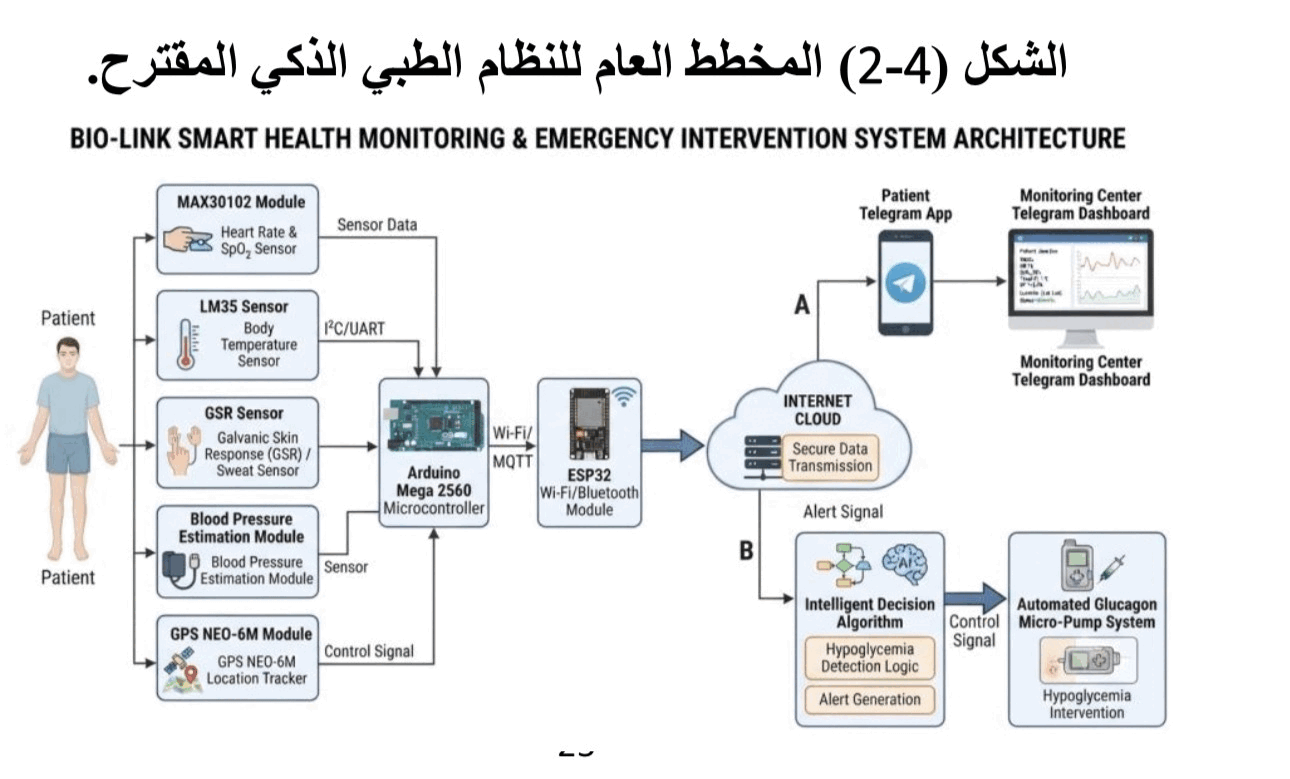
One of the key features of the proposed system is its multi-parameter decision-making mechanism. The system analyzes changes and relationships among multiple physiological signals simultaneously in order to identify patterns that may indicate a blood glucose disturbance. This approach aims to provide a more comprehensive assessment of the patient’s physiological condition compared with systems that rely on a single measurement. The physiological data collected by the sensors integrated into the wristband are transferred to the processing and control units of the system, where they are analyzed and used to determine the appropriate response.
When the decision-making mechanism implemented in the prototype identifies a pattern corresponding to a suspected severe hypoglycemic condition, the system activates an experimental emergency intervention mechanism using a medical pump for subcutaneous glucagon delivery. At the same time, an emergency notification is transmitted remotely through the Telegram platform to a designated monitoring person. The notification includes the measured physiological parameters and the patient’s condition, together with the patient’s geographical location obtained through a GPS module. This enables remote monitoring and provides essential information to support a rapid response, particularly when the patient is unable to request assistance independently.
The proposed system integrates wearable biomedical sensing, embedded data processing, physiological assessment, decision-making, wireless communication, GPS-based localization, and experimental emergency intervention within a single portable and integrated prototype. In this way, the project goes beyond conventional monitoring systems that are limited to collecting measurements or generating alerts, toward an integrated architecture that combines monitoring, intelligent assessment, and emergency response while providing a wearable sensing solution for continuous user monitoring.
The prototype was implemented using an Arduino Mega 2560 as the main control and data-processing unit, while the ESP32 Dev Module provides wireless connectivity and communication with the Telegram platform. The sensing system includes a wearable wristband equipped with a MAX30102 sensor for measuring heart rate and blood oxygen saturation, an LM35 sensor for measuring body temperature, and a GSR sensor for monitoring changes in skin conductance associated with sweating. The system also incorporates a NEO-6M GPS module for geographical localization. In addition, the prototype includes a medical pump and its associated control circuitry to demonstrate the emergency intervention mechanism, with the wristband and the remaining system modules operating as interconnected components of the proposed system.
The project represents a proof-of-concept prototype of an integrated smart medical monitoring and emergency-response system based on wearable sensing, providing a foundation for further development. Future development may include expanding the physiological dataset used for prediction, improving the decision-making algorithm, enhancing measurement accuracy and system reliability, further optimizing the wristband design and integrating its components more effectively, incorporating advanced data-analysis and artificial-intelligence techniques, and conducting broader medical testing and safety studies to evaluate system performance.
The current system is presented as a functional prototype developed for engineering research and development purposes, rather than as a clinically approved medical device. Transitioning to clinical application would require comprehensive medical validation, safety testing, and the necessary medical and regulatory approvals.
Project Design
https://saea-us.org/wp-content/uploads/2026/08/IMG_4979.gif
Needed Material:
Arduino Mega 2560 Rev3 (Original) – 1 unit – $60.96
ESP32 DevKit V1 – 1 unit – $10.38
MAX30102 Heart Rate & SpO₂ Sensor Module – 1 unit – $3.12
LM35DZ/NOPB Temperature Sensor – 1 unit – $2.26
Grove GSR Sensor – 1 unit – $11.99
NEO-6M GPS Module with Antenna – 1 unit – $13.84
12V Peristaltic Medical Pump with Silicone Tubing – 1 unit – $32.38
Push Button for Hypoglycemia Simulation – 1 unit – $0.95
Push Button for Hyperglycemia Simulation – 1 unit – $0.95
Half-Size Breadboard – 1 unit – $4.05
Jumper Wire Set – 1 set – $8.09
Prototype PCB – 1 unit – $4.50
Wearable Silicone Wristband for Sensor Integration – 1 unit – $2.52
International Shipping and Forwarding Costs – estimated $106.00
Prototype integration, sensor mounting, wiring and additional materials – estimated $20.00
Spare components and testing materials – estimated $18.01
All component prices are based on single-unit retail purchases rather than wholesale or bulk quantities. International shipping costs are estimated because the final cost depends on the supplier, shipment weight, shipping method, and destination.