
LunaROS: An AI-Aided Autonomous Telescope System for Celestial Object Detection and Observation.
By:
From: Damascus – HMK – CE
Supervised by: Dr. Hiyam Khaddam
Graduation Year: 2026
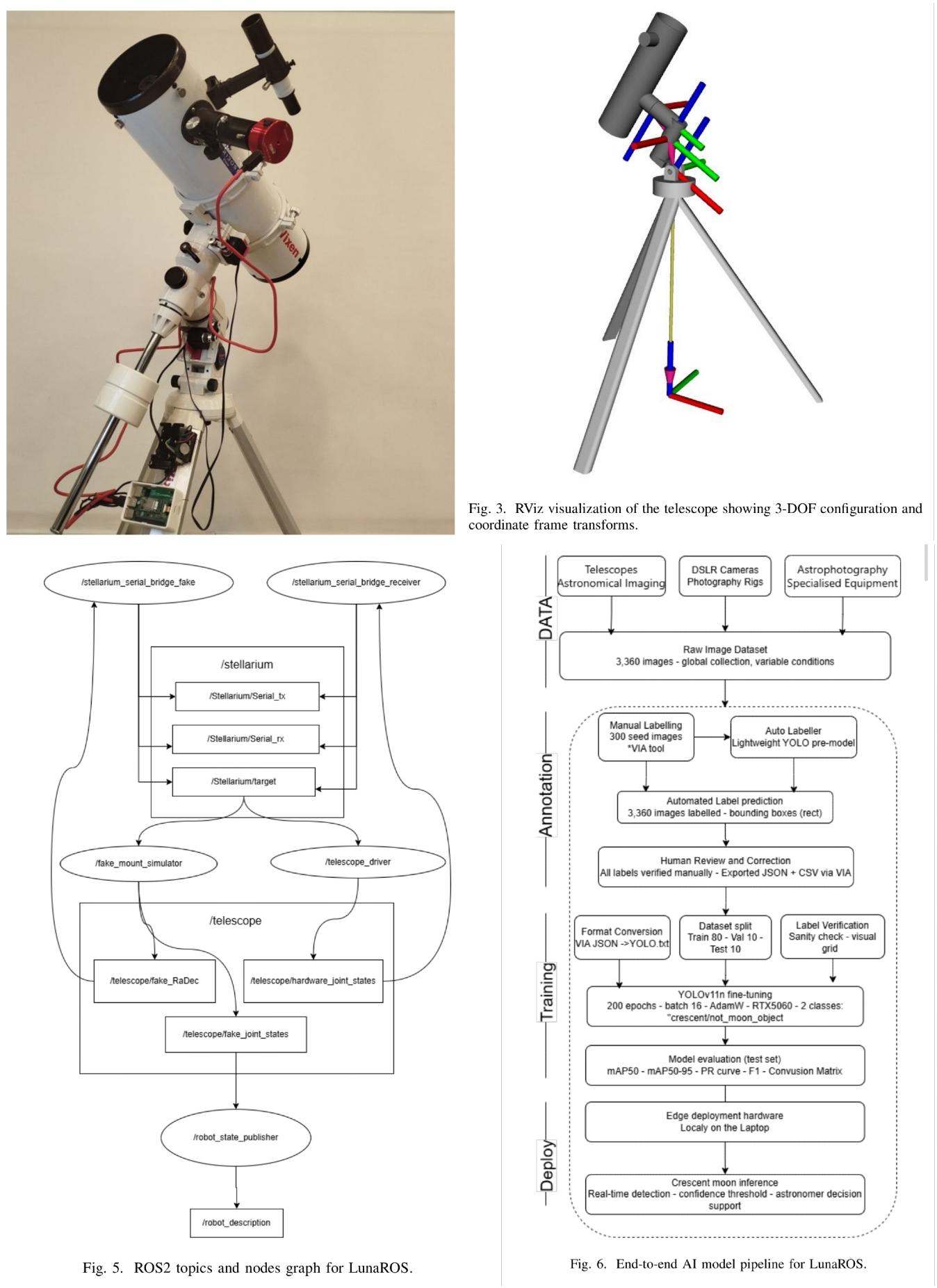
Accurate determination of celestial objects (e.g. Moon, the planets, stars) and aiming at the object is fundamental for astronomers and observers and poses persistent challenges in observational astronomy due to atmospheric conditions, geographic variability, and human error. This project presents LunaROS, an autonomous celestial object detection system that integrates a robotic GoTo telescope, controlled via a ROS2-based architecture that supports both physical and simulated (digital twin) operation. A YOLOv11n model was fine-tuned on approximately 3.5K manually annotated images of the crescent moon from the Islamic Crescents Observation Project (ICOP) and other celestial objects (Sun and planets), enabling real-time inference on an edge device. Experimental results demonstrate reliable detection across diverse imaging conditions, with high precision and recall. This project has proved its scientific credibility through a scientific paper that’s been written and published soon in IEEE conference in late July, in addition to its participation in the Amman Arab University AI & Robotics competition and competing against more than 50 papers in the scientific paper track and finally winning the first place in the same competition. In Addition, this project has proved itself worthy of on-ground deployment by its participation with the Syrian Astronomical Association in helping astronomers to sight the crescent moon of the month Muharram.
Project Design
https://saea-us.org/wp-content/uploads/2026/08/image-3.png
Needed Material:
1- Raspberry PI 5 + AI kit:
The system will prove that it meets the needs and provides further durability when it works on an edge device connected to the telescope.
The AI kit (board + accelerator + storage/cooling/PSU) is a standalone chip that is connected to the Raspberry PI to enhance the performance of the object detection model in real time deployment.
links to the parts:
https://www.waveshare.com/raspberry-pi-5.htm?sku=25838
https://www.waveshare.com/raspberry-pi-ai-kit.htm
Estimated Cost: 360$
2- ST3125 Serial Servo motors:
For telescope guiding and automation.
Each of the 2 motors guides an axis.
The serial servo motors gives a high precision and speed and acceleration values can be set, and the motion effect is softer, in addition to their light weight and smaller size with higher torque than most conventional motors.
Link to the Motor:
https://www.waveshare.com/st3215-servo.htm?sku=22414
Estimated Cost: 50$ for 2 motors
3- Control Board:
For providing an interface with the motors.
Link to the Board:
https://www.waveshare.com/ddsm-driver-hat-b.htm
Estimated Cost: 30$
4- 3D printing of the needed parts:
Each of the motors need a 3D design to attach it to the telescope axis, also goes for the motor controller and Raspberry PI.
Estimated Cost: 50$