
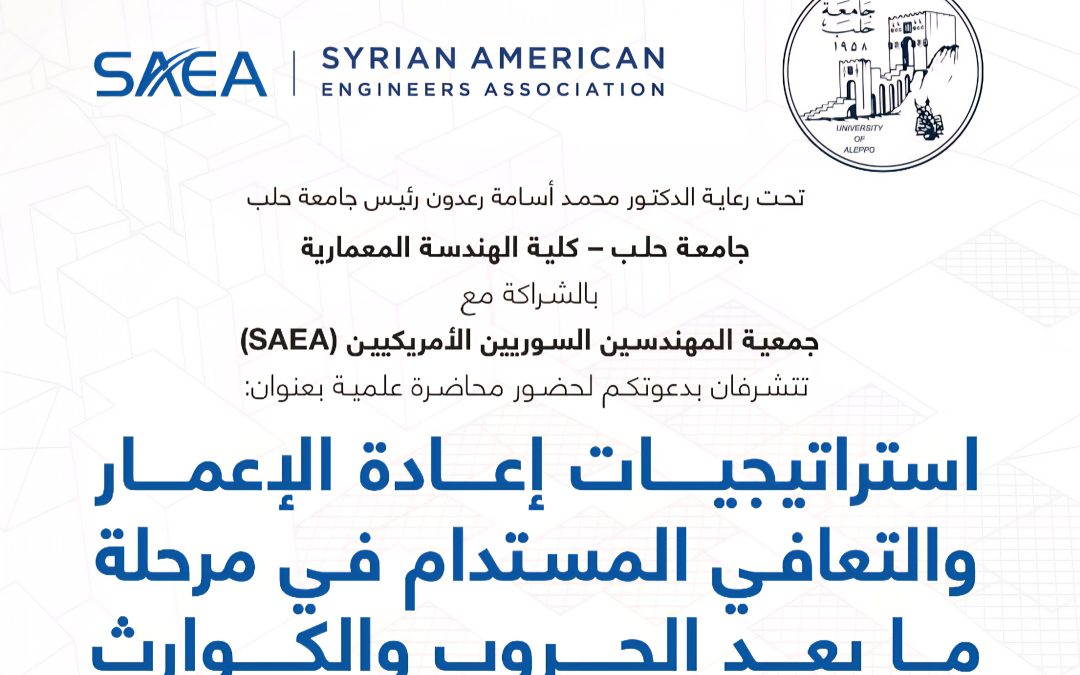
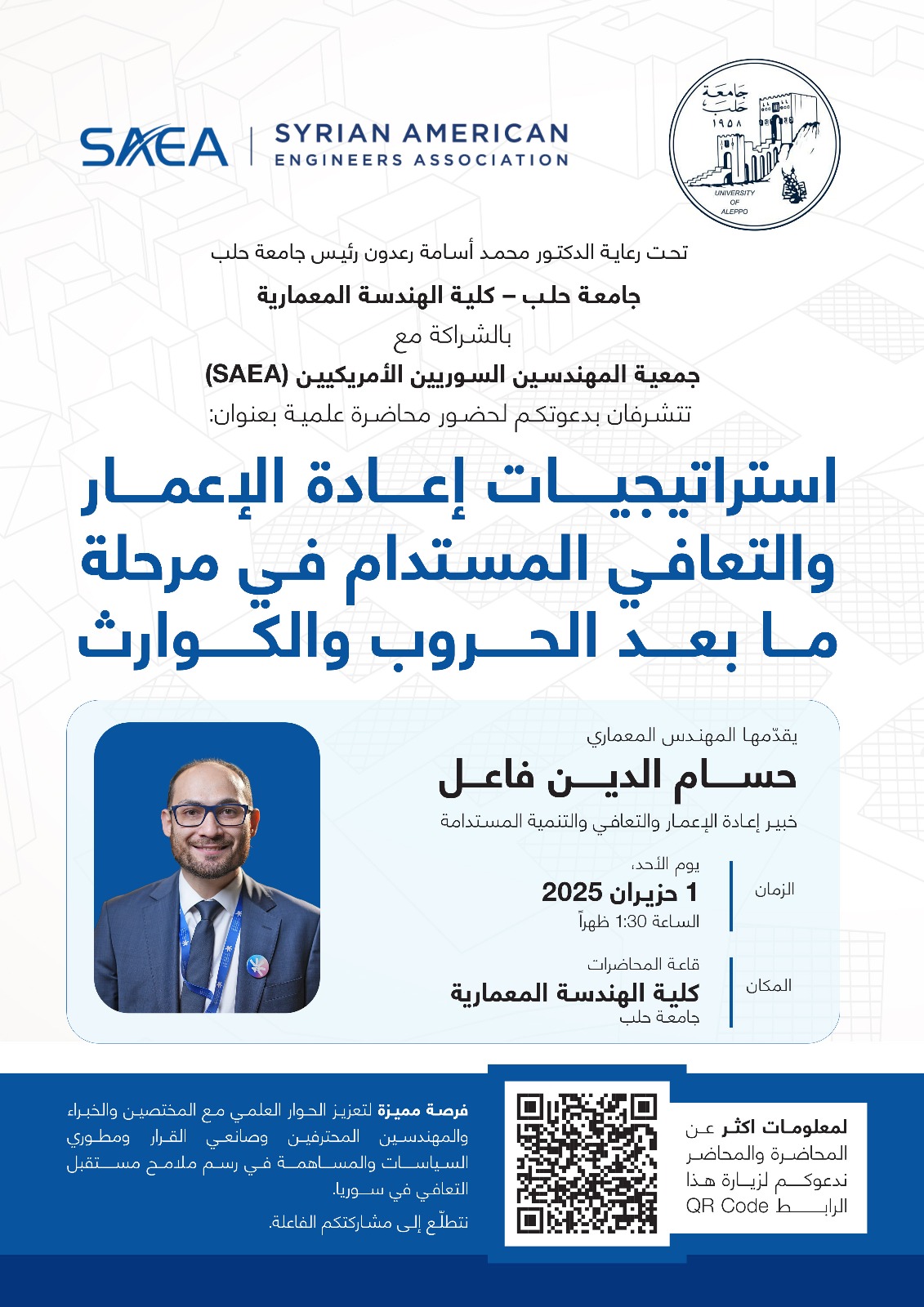
Under the auspices of Dr. Mohammad Osama Radwan, President of the University of Aleppo, the Faculty of Architecture in collaboration with the Syrian American Engineers Association (SAEA) is proud to host a pivotal public lecture entitled:
“Strategies for Sustainable Reconstruction and Recovery in Post-Conflict and Post-Disaster Settings”
Sunday, June 1, 2025 | 1:30 PM
Lecture Hall – Faculty of Architecture, University of Aleppo
Presented by SAEA member Hosam Alddeen Fael, a leading architect and regional expert in sustainable recovery, this session offers a unique perspective into the evolving field of post-war urban planning and strategic reconstruction.
Workshop Outline
As Syria looks toward a future beyond destruction, questions about how to rebuild fairly and sustainably take center stage. In this lecture, Fael delves into the foundational principles of inclusive, community-led recovery, drawing on international case studies and hands-on experience with local contexts such as post-war and post-earthquake Aleppo.
Key topics include:
- The guiding principles of just and sustainable reconstruction
- Context-based strategy development
- Damage classification and prioritization of interventions
- Avoiding land speculation through participatory development models
- Case studies from Turkey (Fikirtepe), Egypt (Maspero Triangle), and Brazil (Favela-Bairro)
The lecture concludes with practical policy recommendations and a dialogue on how to localize global strategies for Syria’s unique challenges and constraints.
Speaker Bio
SAEA member, Hosam Alddeen Fael is a Syrian architect, humanitarian strategist, and the founder of Engineering Gate for Research and Development, a consultancy that works at the intersection of engineering, innovation, and recovery. With over 13 years of experience in conflict and post-conflict zones, Fael has played a pivotal role in major reconstruction and shelter initiatives across Syria and Türkiye.
He served as the Deputy Coordinator of the Shelter/NFI Cluster (Cross-Border Operation – NW Syria) and led national efforts to set shelter repair standards and guidelines for post-disaster rebuilding. His work spans technical innovation—from localized water treatment to transitional shelter prototypes —and he is recognized for championing community-centered recovery planning.
Fael holds a Bachelor’s in Architecture from the University of Aleppo and a Short Master’s in Humanitarian Shelter Coordination from Oxford Brookes University (UK). As an Affiliate Member of SAEA, since 2014 he has contributed to its mission of empowering Syrian professionals worldwide.
Why You Should Attend?
This event is more than a lecture—it's an invitation to be part of Syria's path forward. Join us in rethinking reconstruction not just as rebuilding structures, but as a chance to build a fairer, more resilient society. So this lecture is a must-attend for:
- Students and faculty in architecture, civil engineering, and urban planning
- Government officials from housing, planning, and local governance
- Urban planning experts and technical offices
- Independent professionals in reconstruction and recovery
- Anyone invested in rebuilding Syria responsibly and equitably
Stay tuned on our website and social media for post-event highlights and video recordings.
For more information, please contact PR@SAEA-US.org. We would be happy to share further insights!
To learn more or get involved in SAEA committees and projects, please apply for membership at www.SAEA-US.org/join.
About the Syrian American Engineers Association (SAEA):
The Syrian American Engineers Association (SAEA) is a non-governmental, non-profit professional organization that has supported engineers in Syria and across the diaspora. The Association is committed to enhancing the professional capacity of engineers, advancing engineering standards, and contributing to the rebuilding and development of Syria’s infrastructure. SAEA continues to offer vital resources and expertise to engineers in both the USA and Syria, focusing on damage assessment, infrastructure restoration, and long-term rebuilding efforts.
Recent Comments